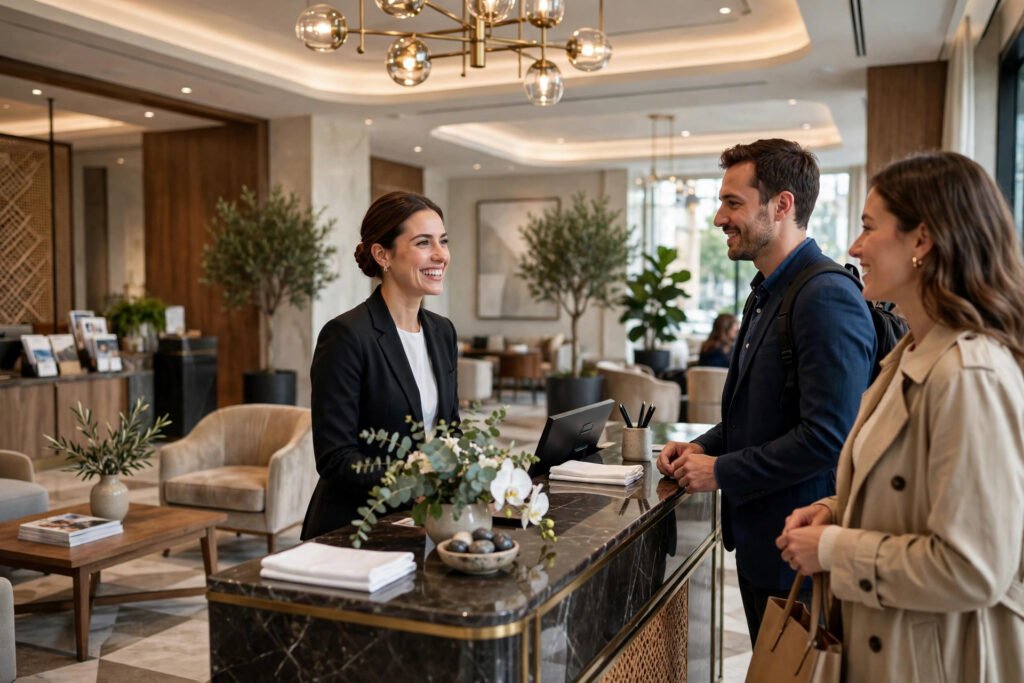
The front desk is the face of the hotel, so interviewers look for warmth, composure, and problem-solving in every candidate. Knowing the most common hotel receptionist interview questions and preparing strong answers gives you a decisive edge. This guide covers the questions you will almost certainly face, with sample answers you can adapt, plus the scenario questions that separate good candidates from great ones.
What Interviewers Are Really Assessing
Beyond your CV, hiring managers evaluate four things: genuine hospitality attitude, communication clarity, calm under pressure, and reliability. Hotels run on shifts, so punctuality and flexibility matter enormously. Every answer you give should quietly demonstrate at least one of these traits. Smile, make eye contact, and treat the interview itself as a demonstration of how you would treat guests.
Common Questions With Sample Answers
Tell me about yourself.
Keep it to ninety seconds: present role or study, relevant customer-facing experience, and why hospitality excites you. Example: I have spent two years in retail customer service, where I learned to handle busy periods calmly and resolve complaints quickly. I am drawn to hotels because I enjoy creating the first impression that shapes a guest entire stay, and I am now looking to bring those skills to a front-desk role.
Why do you want to work at this hotel specifically?
Generic praise fails here. Research the property: mention its reputation, a recent renovation, its location, or its brand values. Example: Your hotel consistently ranks among the top-rated in the city for service, and I want to learn front-office standards at that level. I also admire your focus on personalised guest experiences, which matches how I like to work.
How would you handle an angry guest?
Show the listen, empathise, act sequence. Example: I would listen without interrupting, acknowledge their frustration sincerely, and apologise for the experience. Then I would offer a concrete solution within my authority, such as a room change, and follow up to make sure they were satisfied. If it was beyond my authority, I would involve a supervisor promptly rather than leaving the guest waiting.
What would you do if the hotel were fully booked and a guest arrived with a confirmed reservation?
This tests honesty and procedure. Explain that you would first double-check the system for errors or cancellations, then inform the duty manager immediately, as walking a guest requires management authorisation and usually involves arranging an equivalent nearby hotel plus transport. Never invent a solution alone for overbooking.
Scenario Questions to Practise
- A guest complains about noise at 2am. What do you do?
- Two guests arrive simultaneously and the phone is ringing. How do you prioritise?
- A VIP guest requests something outside normal policy. How do you respond?
- You notice a colleague giving incorrect information to a guest. What do you do?
- The system goes down during check-in rush. How do you cope?
For each, structure your answer as: acknowledge, act within your authority, escalate when needed, follow up. Interviewers want process thinking, not perfect answers.
Questions You Should Ask Them
- What does a typical shift pattern look like, and how is overtime handled?
- What property management system do you use, and is training provided?
- How is performance measured for reception staff here?
- What opportunities exist to progress into supervisory or reservations roles?
Final Preparation Tips
Dress one level above the hotel uniform standard: smart business attire, neat grooming, minimal fragrance. Arrive fifteen minutes early and greet everyone warmly, including the person at the desk, because hotels notice. Bring printed copies of your CV and a list of references. If the interview includes a role-play, stay in character, keep smiling, and narrate your actions so the interviewer sees your thinking.
Key takeaway: Hotel receptionist interviews test attitude and composure more than technical knowledge. Prepare ninety-second answers for the classic questions, practise scenario responses using the acknowledge, act, escalate, follow-up structure, research the property deeply, and treat the whole interview as a live demonstration of guest service.
Frequently Asked Questions
What experience do I need to become a hotel receptionist?
Most hotels hire without prior front-desk experience if you have customer-facing background in retail, restaurants, or call centres. Strong communication, basic computer skills, and a professional manner matter more. Language skills are a major advantage in tourist areas.
How should I dress for a hotel receptionist interview?
Smart business attire: a suit or blazer with a shirt or blouse, polished shoes, and neat grooming. Hotels judge presentation harshly because the role is guest-facing, so aim to look like you already work at the front desk.
What is the typical salary for a hotel receptionist?
Entry-level receptionists in the UK earn 20,000 to 26,000 GBP, while US roles pay 28,000 to 38,000 USD. Luxury properties and night shifts pay premiums, and tips or service charges can add meaningful extra income.
How do I answer the weakness question?
Choose a real, minor weakness and show active improvement. Example: I used to find upselling uncomfortable, so I practised framing upgrades as genuine guest benefits, and my attachment rate improved steadily. Avoid disguised strengths like I work too hard.